
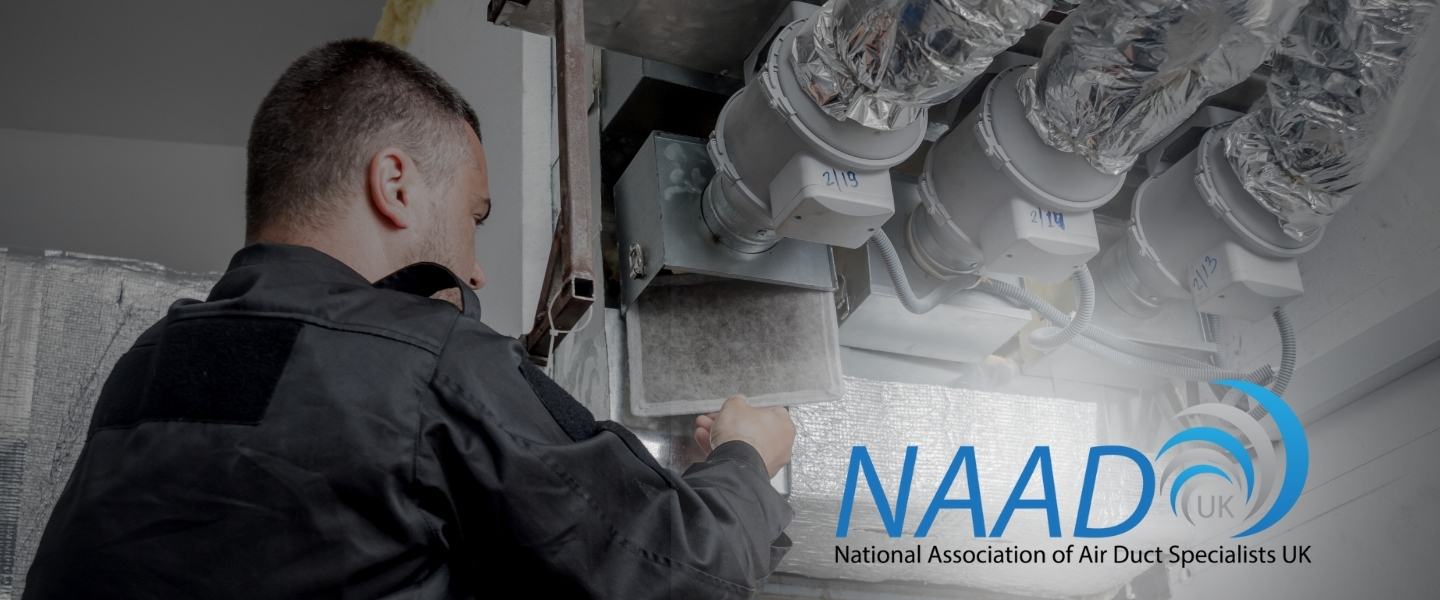
NAAD UK: What It Is, Why It Matters, and How it Protects Your Building
If you manage, own, design, or maintain a building in the UK, air quality and fire safety are your responsibility. That responsibility doesn’t stop at visible systems. It includes the hidden ductwork that moves air, grease, smoke, and contaminants through your property every day.
At The Sweeping Company, we work inside commercial kitchens, hospitals, offices, factories, historic buildings, and homes across the South West. We see first-hand what happens when ductwork is maintained properly and what happens when it is ignored. That’s why we’re NAAD UK certified, so all our work aligns with NAAD21, HTM 03-01, and TR/19 standards.
What is NAAD UK?
NAAD UK stands for the National Association of Air Duct Specialists. It is a UK-based trade association focused on improving standards, safety, and professionalism in air duct cleaning and ventilation hygiene.
NAAD UK exists to solve a long-standing problem in the building services sector. For years, duct cleaning was inconsistently specified, poorly understood, and often delivered without clear standards. NAAD UK introduced structure where there was ambiguity and accountability where there was risk.
From our perspective as an HVAC and chimney services provider, NAAD UK delivers real structure where the industry has historically lacked consistency. It sets out a clear technical framework for how ductwork should be inspected, cleaned, and verified, so expectations are defined rather than assumed.
It also establishes independent training and competency routes for technicians, helping ensure the people carrying out the work understand both the systems they are working on and the risks involved. Crucially, it creates a recognised benchmark that clients, insurers, and regulators can trust when assessing ventilation hygiene standards.
NAAD UK is not a marketing badge. It’s a working framework that raises the bar for how ventilation hygiene is delivered in real buildings.
Why NAAD UK matters to building owners and managers
Ductwork affects more than airflow. It directly impacts fire risk, indoor air quality, energy efficiency, and legal compliance.
When duct systems are poorly maintained, we commonly see:
- Grease accumulation in kitchen extract systems
- Dust and debris restricting airflow
- Microbial growth in supply and return ducts
- Increased fire loading inside concealed spaces
- Systems that fail inspection during audits or insurance reviews
NAAD UK standards address these risks in a practical, measurable way. They set expectations for access provision, cleaning methods, inspection intervals, and post-clean verification.
For building owners and facilities teams, NAAD alignment provides clarity. You know what work should look like, how often it should happen, and how success is measured.
What is NAAD21?
NAAD21 is the technical standard developed by NAAD UK for ventilation system inspection and cleaning. It provides a structured, evidence-based approach to maintaining ductwork across different building types and risk profiles.
NAAD21 covers supply air systems, extract air systems, kitchen grease extract systems, and specialist environments, such as healthcare and laboratories. The standard defines acceptable cleanliness levels, inspection methods, access requirements, and documentation expectations. It replaces vague language with measurable outcomes.
From our point of view on site, NAAD21 removes guesswork. Engineers, clients, and auditors are working from the same rulebook.
How NAAD21 fits into UK fire and safety compliance
NAAD21 does not exist in isolation. It supports compliance with wider UK regulations and guidance, including:
- The Regulatory Reform (Fire Safety) Order
- Insurance policy requirements for commercial kitchens
- HTM and HBN guidance in healthcare settings
- Workplace health and safety duties
Grease-laden ductwork is a recognised fire risk. Dust-filled ventilation systems contribute to poor air quality and equipment failure. NAAD21 provides a defensible maintenance approach that supports your legal duties.
When insurers ask how ductwork is maintained, NAAD21-aligned reports answer that question clearly.
Why training matters in duct cleaning
Ventilation systems are complex, and cleaning them safely requires a solid understanding of airflow design, fire compartments, access engineering, and contamination control.
To support this, NAAD UK operates a dedicated training academy that focuses on real-world competency rather than theory alone. The training covers safe access to ductwork, the correct cleaning methodologies for different systems, inspection techniques including remote visual surveys, and clear reporting and certification standards.
From our perspective as a service provider, this training is essential because it ensures technicians understand exactly what they are working on, how the system functions, and why each step of the process matters.
Domestic vs commercial relevance of NAAD UK
NAAD UK is most commonly associated with commercial buildings, but the principles apply across domestic settings too.
In homes, ducted systems may include:
- Mechanical ventilation with heat recovery (MVHR)
- Kitchen extract systems in multi-occupancy buildings
- Whole-house ventilation systems
Clean ductwork supports healthier indoor air and more efficient systems. NAAD-informed practices help ensure domestic ventilation performs as designed.
NAAD UK and kitchen extract cleaning
Commercial kitchens are one of the highest-risk environments we work in. Grease builds up quickly, and fires can spread rapidly through extract systems if maintenance slips.
NAAD21 sets clear expectations around how often systems should be cleaned based on usage, where access panels should be positioned and how large they need to be, the grease thickness levels that trigger intervention, and how systems are verified once cleaning is complete.
For restaurant owners and facilities managers, NAAD alignment supports safer kitchens, smoother inspections, and stronger relationships with insurers.
NAAD UK and healthcare environments
Healthcare buildings have complex ventilation demands, and air quality directly affects patient safety, infection control, and regulatory compliance. NAAD21 aligns well with healthcare guidance by emphasising risk-based inspection intervals, controlled cleaning methods, and documentation that stands up in audit environments.
In sensitive settings, consistency and traceability matter, and NAAD standards support both.
Inspection, verification, and reporting
One of the strongest aspects of NAAD21 is its focus on evidence.
Cleaning alone is not enough. Systems must be inspected and verified. NAAD21 supports this through:
- Pre-clean surveys
- Post-clean visual inspection
- Photographic and video evidence
- Clear reporting formats
At The Sweeping Company, this approach protects everyone involved. Clients can see what has been done. Engineers can demonstrate quality. Auditors can review objective evidence.
How NAAD UK compares to other standards
The UK ventilation hygiene landscape is shaped by several established standards and guidance documents, each covering a different part of the picture. NAAD21 stands out because it is purpose-built specifically for air duct inspection, cleaning, and verification, rather than being a broader building services or healthcare framework.
In practice, NAAD21 sits comfortably alongside standards such as BS EN 15780, which focuses on ventilation cleanliness levels during installation and operation, and HTM 03-01, which sets expectations for ventilation safety in healthcare environments. In commercial kitchens, it also complements TR19, the industry-recognised guidance produced by Building Engineering Services Association, which defines grease management and fire risk controls in extract systems.
Rather than competing with these documents, NAAD UK provides a practical, technical framework that helps translate high-level requirements into clear, on-site actions. It fills the operational gap by defining how ductwork should be accessed, cleaned, inspected, and reported on in a consistent way. For clients, this alignment reduces grey areas, supports compliance across multiple regulations, and creates clearer expectations about what good ventilation hygiene actually looks like in real buildings.
Choosing a NAAD-certified contractor
NAAD UK provides a practical, industry-led framework that improves outcomes on site. It supports safer buildings, clearer communication, and higher standards of workmanship.
For our clients, NAAD alignment means confidence. You know your ductwork is being maintained properly, documented clearly, and aligned with recognised UK best practice.
When selecting a duct cleaning provider, we recommend asking a few clear questions:
- Do you work to NAAD21 standards?
- How do you inspect and verify cleaning?
- Are you NAAD certified?
- What evidence do you provide after the work?
- How do you assess risk and cleaning frequency?
NAAD UK and the future of ventilation hygiene in the UK
Buildings are becoming more airtight, more complex, and more regulated. Ventilation hygiene will continue to matter.
NAAD UK is playing a central role in shaping how the industry responds. Through training, standards, and advocacy, it’s helping move duct cleaning from an afterthought to a recognised safety discipline. And NAAD21 gives the industry a shared technical standard that works in real buildings.
From our perspective as domestic and commercial chimney sweeps and HVAC cleaning specialists, NAAD alignment supports better outcomes for clients and safer working environments for everyone involved.
If your building relies on ducted ventilation, NAAD standards are worth understanding. They represent where the industry is heading and what good practice looks like today.


